The artificial intelligence landscape has become increasingly competitive, with new models emerging that challenge established players. Two names generating significant buzz are Grok and DeepSeek—each offering unique capabilities that appeal to different user needs. If you're trying to decide between Grok vs DeepSeek, you're not alone. Businesses, developers, and everyday users are weighing their options as these AI chatbots promise powerful performance at different price points.
Grok, developed by xAI (Elon Musk's AI company), brings real-time access to X (formerly Twitter) data and a rebellious personality that sets it apart from more corporate AI assistants. DeepSeek, on the other hand, has disrupted the market with its open-source approach and remarkably low operational costs while delivering competitive performance on industry benchmarks.
This comprehensive comparison will help you understand the strengths and weaknesses of each platform, examining everything from language model architecture to pricing structures, coding capabilities to reasoning performance. Whether you're a developer building applications, a business looking for AI solutions, or simply curious about the latest AI technology, this guide will give you the insights needed to make an informed decision.
Understanding Grok: xAI's Bold Entry into AI
Grok represents Elon Musk's vision for an AI assistant that breaks free from what he perceives as the overly cautious approach of mainstream chatbots. Launched by xAI in late 2023, Grok has evolved through several iterations, with Grok 2 and Grok 3 bringing substantial improvements in reasoning and multimodal capabilities.
What Makes Grok Different
The most distinctive feature of Grok is its integration with X's platform, giving it access to real-time information from millions of posts, trending topics, and breaking news. This real-time data access means Grok can discuss current events with more immediacy than models relying solely on training data with knowledge cutoffs.
Grok's personality is another differentiator. While most AI assistants adopt a neutral, helpful tone, Grok is designed to be more conversational, witty, and occasionally provocative. The system is programmed to answer questions that other AI models might decline, reflecting Musk's stated preference for minimal content restrictions.
The technical foundation of Grok includes a large-scale transformer architecture optimized for both speed and quality. Grok 2, released in 2024, showed significant improvements in mathematical reasoning, coding assistance, and multimodal understanding, including the ability to process images alongside text.
Grok Performance Benchmarks
When evaluating Grok's capabilities, several key performance indicators stand out. On the MMLU (Massive Multitask Language Understanding) benchmark, which tests knowledge across 57 subjects, Grok 2 achieved competitive scores that placed it among the top-tier AI models, though not necessarily at the very top.
In coding benchmarks like HumanEval, Grok demonstrates solid programming capabilities, capable of generating functional code in multiple languages including Python, JavaScript, Java, and C++. The model excels particularly at explaining code logic and debugging, making it useful for developers who need assistance understanding complex codebases.
Grok's mathematical reasoning, tested on benchmarks like GSM8K (grade school math problems) and MATH (more advanced mathematical problems), shows strong performance in step-by-step problem-solving. The model can break down complex calculations and explain its reasoning process, which is valuable for educational applications.
Limitations and Considerations
Despite its strengths, Grok has some notable limitations. The model's access to real-time X data, while powerful, can also introduce noise and potentially unreliable information, since social media content isn't always accurate or verified. Users need to exercise critical thinking when Grok references trending topics or breaking news.
Availability is another factor—Grok access has historically been limited to X Premium subscribers, creating a barrier to entry compared to more openly accessible AI chatbots. The pricing structure ties Grok usage to social media platform subscriptions, which may not appeal to users who simply want AI capabilities without the social networking component.
DeepSeek: The Open-Source Challenger
DeepSeek emerged from China as a formidable competitor in the AI space, particularly gaining attention with DeepSeek V3 and the specialized DeepSeek-R1 reasoning model. What makes DeepSeek remarkable isn't just its performance—it's the combination of impressive capabilities with surprisingly low development and operational costs.
The DeepSeek Advantage
DeepSeek's primary advantage lies in its cost-efficiency. The company claims to have trained DeepSeek V3, a massive 671-billion parameter model, for less than $6 million—a fraction of what competitors reportedly spend on similar-scale models. This efficiency extends to inference costs, with DeepSeek offering API access at prices significantly below OpenAI, Anthropic, and Google.
The open-source nature of DeepSeek models represents another major advantage. Developers can download model weights, fine-tune them for specific applications, and deploy them on their own infrastructure. This transparency appeals to organizations concerned about data privacy, vendor lock-in, or the need for customization.
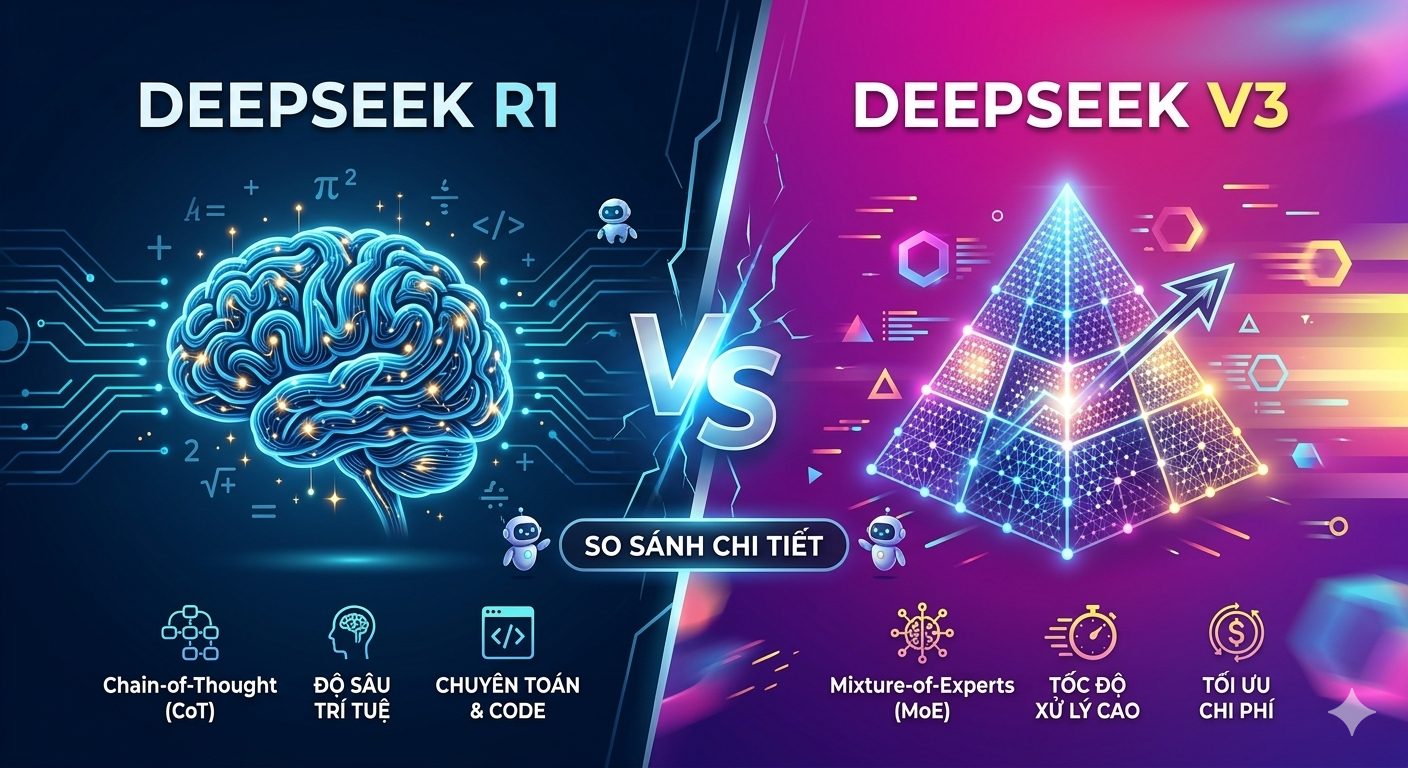
DeepSeek's technical architecture incorporates innovative approaches to efficiency. The model uses a mixture-of-experts (MoE) design, where different specialized sub-networks activate depending on the type of query. This allows DeepSeek to maintain high performance while keeping computational costs manageable. Only a fraction of the model's parameters are active for any given task, reducing the resources needed for each inference.
DeepSeek Performance Analysis
Performance benchmarks reveal that DeepSeek competes effectively with much more expensive models. On the MMLU benchmark, DeepSeek V3 achieves scores comparable to GPT-4 and Claude, demonstrating broad knowledge across diverse subjects. This is particularly impressive given the model's lower training costs.
In coding tasks, DeepSeek shows exceptional capability. On HumanEval and other programming benchmarks, DeepSeek frequently matches or exceeds the performance of GPT-4, making it a serious option for software development applications. The model handles multiple programming languages well and can assist with everything from writing new functions to debugging existing code.
The DeepSeek-R1 model deserves special mention for its reasoning capabilities. This specialized variant incorporates chain-of-thought reasoning techniques that allow it to tackle complex multi-step problems. On mathematical reasoning benchmarks like AIME (American Invitational Mathematics Examination) and competitive programming challenges, DeepSeek-R1 has demonstrated performance rivaling or exceeding OpenAI's o1 reasoning model.
DeepSeek Challenges
DeepSeek isn't without drawbacks. The model's training data and some of its behaviors reflect its Chinese origins, including certain content restrictions around politically sensitive topics. For users in Western markets, this can occasionally result in unexpected refusals or evasive responses to questions about specific geopolitical issues.
Language performance is another consideration. While DeepSeek handles English competently, some users report that it occasionally produces slightly awkward phrasing or exhibits subtle translation artifacts, suggesting that Chinese language data played a significant role in training. For English-dominant use cases, this might result in a less polished experience compared to models specifically optimized for English.
The availability and reliability of DeepSeek's API services have also faced challenges. As a relatively newer player with rapidly growing demand, the company has experienced occasional service disruptions and capacity constraints. Users building critical applications need to consider these reliability factors when choosing their AI infrastructure.
Grok vs DeepSeek: Direct Comparison
Now that we've explored each platform individually, let's directly compare Grok vs DeepSeek across the dimensions that matter most to users.
Language Understanding and General Knowledge
Both Grok and DeepSeek demonstrate strong language understanding capabilities, but they excel in different areas. Grok benefits from its integration with current X data, making it particularly strong when discussing recent events, trending topics, and contemporary cultural references. If you ask Grok about something that happened yesterday or is currently trending, it can incorporate real-time information into its response.
DeepSeek, while limited to its training data cutoff, shows impressive breadth of knowledge across academic subjects, technical domains, and general information. The model's performance on standardized benchmarks like MMLU suggests comprehensive knowledge acquisition during training. For questions about established facts, scientific concepts, historical events, or technical documentation, DeepSeek provides reliable, well-structured answers.
In terms of conversation quality, Grok's more casual, personality-driven approach contrasts with DeepSeek's more neutral, straightforward communication style. Some users prefer Grok's witty responses and willingness to engage with controversial topics, while others appreciate DeepSeek's focused, professional tone.
Coding and Programming Assistance
For developers, coding capability is often a deciding factor when choosing an AI assistant. In the Grok vs DeepSeek comparison, both models demonstrate strong programming skills, but with different strengths.
Grok excels at explaining code in conversational terms, making it accessible for beginners learning to program. The model can walk through code logic step-by-step, explain why certain approaches work better than others, and provide context about programming best practices. For educational purposes and collaborative debugging, Grok's explanatory abilities shine.
DeepSeek, particularly the V3 model, shows exceptional code generation capabilities. On competitive programming benchmarks and complex algorithm implementation tasks, DeepSeek frequently produces cleaner, more efficient code. The model seems particularly strong with Python, JavaScript, and other popular languages, generating production-ready code that requires minimal modification.
Both models can handle multiple programming languages, assist with debugging, explain error messages, and suggest optimizations. However, DeepSeek's open-source nature provides an additional advantage—developers can fine-tune the model on their organization's specific coding standards, internal libraries, or domain-specific programming challenges.
Mathematical Reasoning and Problem Solving
Mathematical reasoning represents a crucial test of AI capability, as it requires logical thinking, multi-step problem solving, and precise calculation—skills that extend beyond pattern matching.
Grok demonstrates solid mathematical abilities, handling grade-school through college-level problems with reasonable accuracy. The model shows its work, explaining each step of the solution process, which is valuable for students and anyone trying to understand mathematical concepts rather than just getting answers.
DeepSeek-R1, the specialized reasoning variant, pushes mathematical capabilities significantly further. On advanced math benchmarks including competition-level problems, DeepSeek-R1 achieves impressive results. The model's chain-of-thought reasoning allows it to tackle complex proofs, multi-step word problems, and abstract mathematical concepts with sophistication approaching human expert level in some domains.
For users who regularly need assistance with advanced mathematics, scientific computing, or quantitative analysis, DeepSeek-R1 represents the stronger choice. For more typical math help—homework assistance, financial calculations, or basic statistics—both models perform adequately.
Real-Time Information and Current Events
This is where Grok vs DeepSeek shows the clearest differentiation. Grok's integration with X gives it a substantial advantage for any queries related to current events, breaking news, trending topics, or rapidly evolving situations. If you need to understand what's happening right now—election results, sports scores, product launches, or social media trends—Grok can incorporate the latest information.
DeepSeek, like most AI models, is limited to its training data cutoff. While the model can reason about hypothetical current events and provide general analysis frameworks, it cannot access actual real-time information. For users whose work requires staying current with news, monitoring social conversations, or understanding real-time developments, this limitation is significant.
However, this advantage comes with caveats. Social media data, while current, isn't always accurate, verified, or representative. Grok's real-time information can include rumors, misinformation, or fringe perspectives that happen to be trending. Users need to apply critical evaluation to Grok's real-time insights.
Privacy and Data Considerations
Data privacy represents an increasingly important factor in AI selection, particularly for businesses handling sensitive information.
Grok's integration with X raises questions about data flows and privacy. Queries submitted to Grok could potentially be used to improve the model or inform X's broader platform operations. The connection between AI usage and social media activity may concern users who prefer to keep their AI interactions separate from their social media presence.
DeepSeek's open-source models offer greater privacy control. Organizations can download model weights and run DeepSeek entirely on their own infrastructure, ensuring that sensitive data never leaves their environment. This self-hosting capability is particularly valuable for industries with strict data governance requirements—healthcare, finance, legal services, and government applications.
For API usage, both platforms process queries on their servers, with the standard data retention and usage policies that accompany cloud AI services. Users should review the specific terms of service for each platform to understand how their data is handled.
Cost and Accessibility
Cost considerations often determine which AI solution is practical for different use cases. The Grok vs DeepSeek comparison reveals dramatically different pricing approaches.
Grok access is tied to X Premium subscriptions, which cost approximately $8-16 per month depending on the tier and features selected. This provides unlimited conversational access to Grok within the X platform, making it economical for individual users who want powerful AI capabilities bundled with their social media experience.
DeepSeek disrupted the market with remarkably low API pricing—significantly cheaper than GPT-4, Claude, or Gemini on a per-token basis. For developers building applications that make thousands or millions of API calls, this cost difference becomes substantial. DeepSeek's pricing makes it feasible to incorporate AI into applications where GPT-4's costs would be prohibitive.
The open-source availability of DeepSeek models creates additional value. Organizations can eliminate per-use API costs entirely by running models on their own hardware, trading operational expenses for upfront infrastructure investment. This model appeals to companies with existing computational resources and technical expertise.
Real-World Use Cases: When to Choose Each
Understanding when to choose Grok vs DeepSeek depends largely on your specific use case and priorities.
Choose Grok When You Need
- Real-time social intelligence: If your work involves monitoring social conversations, understanding trending topics, or staying ahead of rapidly evolving news, Grok's X integration provides unique value. Marketing professionals, journalists, and social media managers benefit from this real-time connectivity.
- Conversational personality: Users who prefer AI assistants with personality—wit, humor, and a more casual communication style—often appreciate Grok's approach. This makes interactions feel less transactional and more engaging for general conversation and brainstorming sessions.
- Simplified access: For individuals who want powerful AI without managing API keys, setting up development environments, or dealing with technical complexity, Grok's integration into X Premium offers straightforward access through a familiar interface.
- Content moderation flexibility: Grok's more permissive approach to controversial topics appeals to users frustrated by other AI models' refusals. While this comes with responsibility to use the tool ethically, it provides greater freedom for creative work, philosophical discussions, and exploratory conversations.
Choose DeepSeek When You Need
- Cost-effective API access: Developers building commercial applications with substantial API usage volumes benefit dramatically from DeepSeek's lower pricing. The cost savings can make the difference between a viable business model and an unprofitable one.
- Open-source flexibility: Organizations requiring model customization, fine-tuning, or self-hosting capabilities should prioritize DeepSeek. The ability to modify and deploy models on your own infrastructure provides control impossible with proprietary APIs.
- Advanced reasoning tasks: For applications involving complex mathematics, competitive programming, or sophisticated multi-step reasoning, DeepSeek-R1 demonstrates capabilities that rival or exceed much more expensive alternatives.
- Privacy-sensitive applications: Healthcare systems, financial institutions, and other organizations with strict data governance requirements benefit from DeepSeek's ability to run entirely on-premises without data leaving their secure environment.
- Multilingual applications: While both models handle multiple languages, DeepSeek shows particularly strong performance on Chinese language tasks, making it valuable for applications serving Chinese-speaking users or requiring Chinese-English translation.
Accessing Multiple AI Models with Chat Smith
While understanding the Grok vs DeepSeek comparison helps you appreciate each platform's strengths, many users find that no single AI model perfectly meets all their needs. This is where Chat Smith, available at chatsmith.io, offers a compelling solution.
Why Use Chat Smith for Grok and DeepSeek
Chat Smith provides unified access to multiple leading AI models, including ChatGPT, Gemini, DeepSeek, and Grok, through a single, streamlined interface. Rather than maintaining separate subscriptions, managing different API keys, or switching between multiple platforms, you can access all these models from one place.
This multi-model approach delivers several practical advantages:
- Choose the best tool for each task: Instead of being locked into one AI model's strengths and weaknesses, you can select the optimal model for each specific query. Use Grok when you need real-time social insights, switch to DeepSeek for complex coding challenges, leverage ChatGPT for creative writing, or tap Gemini for multimodal tasks—all without leaving your workflow.
- Compare responses side-by-side: When facing important decisions or complex problems, Chat Smith allows you to query multiple models simultaneously and compare their responses. This multi-perspective approach often reveals insights that any single model might miss, giving you more comprehensive answers to challenging questions.
- Simplified cost management: Rather than juggling multiple subscriptions and API accounts, Chat Smith consolidates your AI expenses into a single, predictable platform. This simplifies budgeting and can reduce overall costs compared to maintaining separate premium subscriptions to multiple services.
- Unified conversation history: Your interactions across all models are stored in one place, making it easy to revisit past conversations, track how different models handled similar queries, and maintain continuity in your work.
How Chat Smith Enhances Your AI Experience
Chat Smith isn't just about access—it's about making AI more practical and powerful for real-world work:
The platform's interface is designed for productivity, eliminating the friction of switching between different AI services. Whether you're a developer who needs quick access to DeepSeek's coding capabilities, a content creator who relies on various models for different writing styles, or a researcher who benefits from multiple AI perspectives, Chat Smith streamlines your workflow.
For businesses, Chat Smith provides a centralized solution that simplifies AI adoption across teams. Rather than each department choosing different AI tools and creating a fragmented technology landscape, organizations can provide unified access to multiple models through a single platform with consolidated management and billing.
The integration of Grok and DeepSeek alongside ChatGPT and Gemini means you're not forced to choose in the Grok vs DeepSeek debate—you can leverage both, using each where it excels. When you need Grok's real-time social intelligence, it's there. When you require DeepSeek's cost-effective reasoning capabilities, you can access that too.
Getting Started with Chat Smith
Setting up Chat Smith is straightforward. Visit chatsmith.io to create an account and begin exploring the platform. The service is designed to be intuitive, with clear documentation and responsive support to help you maximize the value of having multiple AI models at your fingertips.
Whether you're an individual looking to enhance your productivity, a small business seeking competitive AI capabilities, or an enterprise requiring robust, flexible AI infrastructure, Chat Smith provides a practical solution that leverages the best of Grok, DeepSeek, and other leading models.
Technical Deep Dive: Architecture and Innovation
For those interested in the underlying technology, understanding how Grok and DeepSeek achieve their capabilities provides insight into their different approaches to AI development.
Grok's Technical Foundation
Grok is built on a large-scale transformer architecture, the neural network design that has dominated AI language models since 2017. The model uses attention mechanisms to process relationships between words in context, allowing it to understand nuance, maintain coherence over long conversations, and generate human-like text.
What distinguishes Grok technically is its integration layer with X's data streams. The model includes specialized components for processing, filtering, and incorporating real-time social media data into its knowledge base. This requires sophisticated systems for relevance ranking, fact-checking indicators, and temporal awareness—understanding that information from five minutes ago is more current than information from last week.
Grok's training process likely incorporated large amounts of social media text, giving the model familiarity with informal language, internet culture, memes, and the conversational patterns common in online discussions. This training approach contributes to Grok's more casual, personality-driven communication style.
The model's multimodal capabilities, introduced in Grok 2, allow it to process images alongside text. This vision-language integration uses separate encoder networks for visual information, which then interact with the text processing components through cross-attention mechanisms. Users can share images and ask Grok to analyze them, describe content, or answer questions about what it sees.
DeepSeek's Innovative Approach
DeepSeek's architecture incorporates several innovations that contribute to its impressive cost-efficiency without sacrificing performance. The mixture-of-experts (MoE) design represents the core innovation, dividing the model into specialized sub-networks.
In a traditional dense model, every parameter participates in processing every input. With 671 billion parameters, this creates enormous computational requirements. DeepSeek's MoE architecture activates only a subset of experts for each query—perhaps 40-50 billion parameters out of the total 671 billion. A routing mechanism decides which experts are most relevant for the current task, activating only those experts while keeping others dormant.
This selective activation dramatically reduces computational costs during inference while maintaining the knowledge and capability of the full model. Different experts specialize in different domains—some might focus on mathematical reasoning, others on coding, still others on language understanding or creative writing. The routing system learns during training which combinations of experts work best for different types of queries.
DeepSeek also employs aggressive quantization techniques, reducing the precision of model weights from 32-bit or 16-bit floating-point numbers to 8-bit or even 4-bit representations. This reduces memory requirements and speeds up computation with minimal impact on output quality. The company has invested heavily in optimizing these quantization approaches to maintain performance while maximizing efficiency.
The training process for DeepSeek models incorporates massive datasets spanning multiple languages, with particular strength in Chinese and English. The training infrastructure uses custom optimizations and efficient distributed training techniques that allowed the company to achieve impressive results with lower computational budgets than competitors.
DeepSeek-R1, the reasoning-specialized variant, adds explicit chain-of-thought processing. The model is trained not just to produce answers but to generate step-by-step reasoning processes, showing its work as it solves problems. This transparent reasoning allows users to verify the model's logic and catches errors that might occur in single-step predictions.
Benchmark Performance Summary
Understanding how Grok and DeepSeek perform on standardized benchmarks provides objective comparison points, though real-world performance always includes factors beyond benchmarks.
Both models achieve competitive scores on MMLU, the comprehensive knowledge benchmark spanning 57 subjects from mathematics to law to history. Grok scores in the 80-85% range depending on the version, while DeepSeek V3 achieves similar results, with both placing among the top-tier models available.
For coding capability, as measured by HumanEval (Python programming) and MultiPL-E (multiple languages), DeepSeek shows particular strength, often matching or exceeding GPT-4 performance. Grok demonstrates solid coding capability as well, though typically slightly behind DeepSeek in pure code generation accuracy.
Mathematical reasoning benchmarks reveal DeepSeek-R1's particular strength. On GSM8K, a benchmark of grade-school math problems, DeepSeek-R1 achieves scores above 90%, demonstrating strong basic mathematical reasoning. On the more challenging MATH benchmark featuring competition-level problems, DeepSeek-R1 shows impressive capabilities that compete with OpenAI's specialized reasoning models.
The AIME (American Invitational Mathematics Examination) benchmark, featuring extremely challenging high-school mathematics competition problems, represents a difficult test where even advanced models struggle. DeepSeek-R1 has demonstrated notable performance here, solving problems that require sophisticated mathematical insight and multi-step reasoning chains.
For natural language understanding and generation, both models perform well on benchmarks like HellaSwag (commonsense reasoning) and WinoGrande (pronoun resolution), showing strong grasp of linguistic nuance and contextual understanding.
The Broader AI Landscape Context
The Grok vs DeepSeek comparison doesn't exist in isolation—both models compete within a rapidly evolving AI landscape featuring multiple powerful alternatives.
ChatGPT from OpenAI remains the most widely recognized AI assistant, with GPT-4 setting performance standards that newer models target. The introduction of ChatGPT's reasoning model o1 raised the bar for complex problem-solving capabilities, particularly in mathematics and coding.
Claude from Anthropic has built a reputation for thoughtful, nuanced responses and strong performance on reasoning tasks. Many users praise Claude for its writing quality and ability to engage with complex ethical and philosophical questions.
Gemini from Google leverages the search giant's vast data resources and deep technical expertise, with particular strength in multimodal capabilities and integration with Google's ecosystem of productivity tools.
DeepSeek's emergence challenged the assumption that cutting-edge AI requires massive budgets, proving that innovative architecture and training techniques can achieve impressive results more efficiently. This has pressured established players to improve their own cost structures and raised questions about the sustainability of extremely expensive training runs.
Grok's integration of real-time social data represents a different kind of innovation—not primarily architectural, but in how AI connects to living, evolving information streams. This points toward a future where AI models don't just rely on fixed training data but maintain connections to current information sources.
The open-source movement in AI, which DeepSeek contributes to, contrasts with the more closed approach of companies like OpenAI and xAI. This philosophical difference—open versus proprietary—shapes not just technical access but also questions of AI governance, safety, and equitable distribution of AI benefits.
Future Developments and Roadmap
Both Grok and DeepSeek continue to evolve rapidly, with expected improvements that will shift the competitive landscape.
For Grok, xAI has announced plans for continued model improvements, including expanded multimodal capabilities, enhanced reasoning, and potentially deeper integration with X's platform features. The company's substantial funding and Elon Musk's high-profile advocacy suggest continued investment in making Grok a leading AI assistant.
Grok's future likely includes more sophisticated real-time data integration, potentially expanding beyond X to incorporate other live data sources. Enhanced fact-checking capabilities and source attribution could address some of the challenges associated with social media information reliability.
DeepSeek's roadmap appears focused on pushing efficiency further while maintaining performance improvements. The company has demonstrated rapid iteration, with significant model releases following relatively quickly after one another. Future versions will likely continue optimizing the balance between capability and cost.
The open-source community around DeepSeek contributes to its evolution in ways that proprietary models can't match. Researchers worldwide are fine-tuning DeepSeek models for specialized applications, discovering novel use cases, and contributing insights back to the broader AI community. This ecosystem effect amplifies DeepSeek's impact beyond what the core company alone could achieve.
Both models will face increasing competition not just from each other but from established players like OpenAI, Anthropic, and Google, plus emerging challengers from around the world. The AI field's rapid pace of innovation means that today's leading models may be overtaken within months by new architectures, training techniques, or data strategies.
Making Your Decision
After examining all these factors, how should you actually decide between Grok vs DeepSeek for your needs?
Start by identifying your primary use case. If real-time social intelligence is central to your work, Grok's unique capabilities make it difficult to replace. If you're building applications with significant API usage volumes, DeepSeek's cost advantages may be decisive.
Consider your technical sophistication. Users comfortable with APIs, development environments, and technical documentation will find DeepSeek's open-source nature empowering. Those preferring simple, consumer-friendly interfaces might appreciate Grok's integration into a familiar social platform.
Evaluate your budget and cost structure. Individual users paying their own subscription fees face different calculations than businesses with large-scale API usage. Run the numbers based on your expected usage patterns.
Think about privacy and data governance requirements. Organizations in regulated industries or handling sensitive information should prioritize solutions that offer greater control, which often favors DeepSeek's self-hosting capabilities.
Consider using both models for different purposes, potentially through a unified platform like Chat Smith that provides access to multiple AI models. This approach avoids forcing a single choice when different tools excel at different tasks.
Test both platforms with your actual use cases. Theoretical comparisons matter less than real-world performance on your specific tasks. Most services offer trial periods or limited free access that allows hands-on evaluation before committing.
Conclusion
The Grok vs DeepSeek comparison reveals two distinct approaches to AI development, each with legitimate strengths for different use cases. Grok brings real-time connectivity and personality to AI interaction, making it particularly valuable for social intelligence and current events. DeepSeek demonstrates that exceptional AI capabilities can be achieved efficiently, providing powerful performance at accessible costs with open-source flexibility.
For most users, the decision doesn't require choosing one over the other permanently. The AI landscape benefits from multiple strong competitors pushing each other toward better performance, lower costs, and innovative features. Rather than limiting yourself to a single platform, consider embracing a multi-model strategy that leverages the unique strengths of each system.
Frequently Asked Questions
1. Is DeepSeek better than Grok for coding?
DeepSeek generally shows stronger pure code generation capabilities based on benchmark performance, particularly on competitive programming tasks. The model produces clean, efficient code across multiple programming languages. However, Grok excels at explaining code concepts in accessible language, making it valuable for learning and collaborative debugging. For production code generation at scale, DeepSeek's combination of performance and cost-efficiency gives it an edge. For educational purposes or explaining existing code, both models perform well with Grok offering a more conversational approach.
2. Can Grok access real-time information better than DeepSeek?
Yes, Grok's integration with X provides unique real-time information access that DeepSeek cannot match. Grok can reference trending topics, breaking news, and current social conversations happening on the platform. DeepSeek is limited to its training data cutoff and cannot access current information without external tools. This makes Grok substantially better for queries about current events, trending topics, or rapidly evolving situations. However, real-time social media data isn't always accurate, so users should verify important information through authoritative sources.
3. Which AI model is more cost-effective for businesses?
DeepSeek typically offers greater cost-effectiveness for businesses with substantial API usage. The per-token pricing is significantly lower than most competitors, making it feasible to incorporate AI into applications where costs would otherwise be prohibitive. For businesses that can self-host, DeepSeek's open-source models eliminate per-use API costs entirely. Grok's pricing is tied to X Premium subscriptions, which makes sense for individual users or small teams but may not scale efficiently for large enterprise applications requiring programmatic access.
4. How do Grok and DeepSeek compare to ChatGPT?
Grok differentiates itself from ChatGPT primarily through real-time X data integration and a more permissive, personality-driven approach. ChatGPT (GPT-4) generally shows stronger performance on most standardized benchmarks and offers more polished language generation. DeepSeek competes directly with ChatGPT on performance while offering dramatically lower costs and open-source availability. For many applications, DeepSeek's cost-to-performance ratio makes it an attractive GPT-4 alternative, particularly for development and API integration. The choice depends on whether you value ChatGPT's performance ceiling or DeepSeek's efficiency and openness.
5. Can I use both Grok and DeepSeek together?
Yes, using both models together for different purposes can be an effective strategy. Platforms like Chat Smith provide unified access to multiple AI models including both Grok and DeepSeek, allowing you to choose the best tool for each specific task. You might use Grok for social listening and current events analysis while leveraging DeepSeek for coding projects and complex reasoning tasks. This multi-model approach avoids the limitations of relying on a single AI assistant and lets you capitalize on each model's particular strengths.
6. Is DeepSeek really open source?
DeepSeek releases model weights under licenses that allow downloading, modification, and commercial use, which qualifies as open source by common definitions. However, some proprietary components and the full training data aren't publicly available. For most practical purposes—fine-tuning, self-hosting, customization—DeepSeek provides the openness developers need. This contrasts with completely proprietary models like Grok, where access is limited to API calls or platform integration without visibility into model internals.
7. Which model is better for mathematical reasoning?
DeepSeek-R1, the reasoning-specialized variant, demonstrates exceptional mathematical capabilities that compete with the best available models. On advanced mathematics benchmarks including competition-level problems, DeepSeek-R1 shows performance that often matches or exceeds OpenAI's o1 reasoning model. For grade-school through college-level mathematics, both Grok and standard DeepSeek variants perform competently. If advanced mathematical reasoning is a primary requirement, DeepSeek-R1 represents the stronger choice based on current benchmark results.
8. Does Grok work better for creative writing?
Grok's personality-driven approach and more permissive content policies can make it feel more engaging for creative writing projects, particularly those involving edgy, controversial, or unconventional content. The model's conversational style may spark ideas and feel more collaborative for some writers. However, DeepSeek and other models match or exceed Grok's pure language generation quality. The choice for creative writing depends more on personal preference for interaction style than objective capability differences. Many writers benefit from experimenting with multiple models to find which one meshes best with their creative process.
9. Can DeepSeek be customized for specific industries?
Yes, DeepSeek's open-source nature allows extensive customization through fine-tuning on domain-specific data. Organizations can adapt the model for specialized vocabularies, industry-specific tasks, or proprietary workflows. This flexibility is particularly valuable for healthcare, legal, financial services, and other fields with specialized language and requirements. The fine-tuning process requires technical expertise and computational resources, but it enables customization impossible with proprietary APIs. For businesses requiring tailored AI capabilities, this represents a significant advantage over closed models like Grok.
10. How reliable is Grok's real-time information?
Grok's real-time information reflects whatever is being discussed on X at the time, which means reliability varies significantly by topic. For factual breaking news covered by reliable journalists and news organizations, Grok can provide valuable current information. For topics prone to misinformation, speculation, or coordinated manipulation, the information may be less reliable. Users should treat Grok's real-time insights as starting points for further investigation rather than definitive facts, particularly for important decisions. Cross-referencing with authoritative sources remains essential for any critical information.