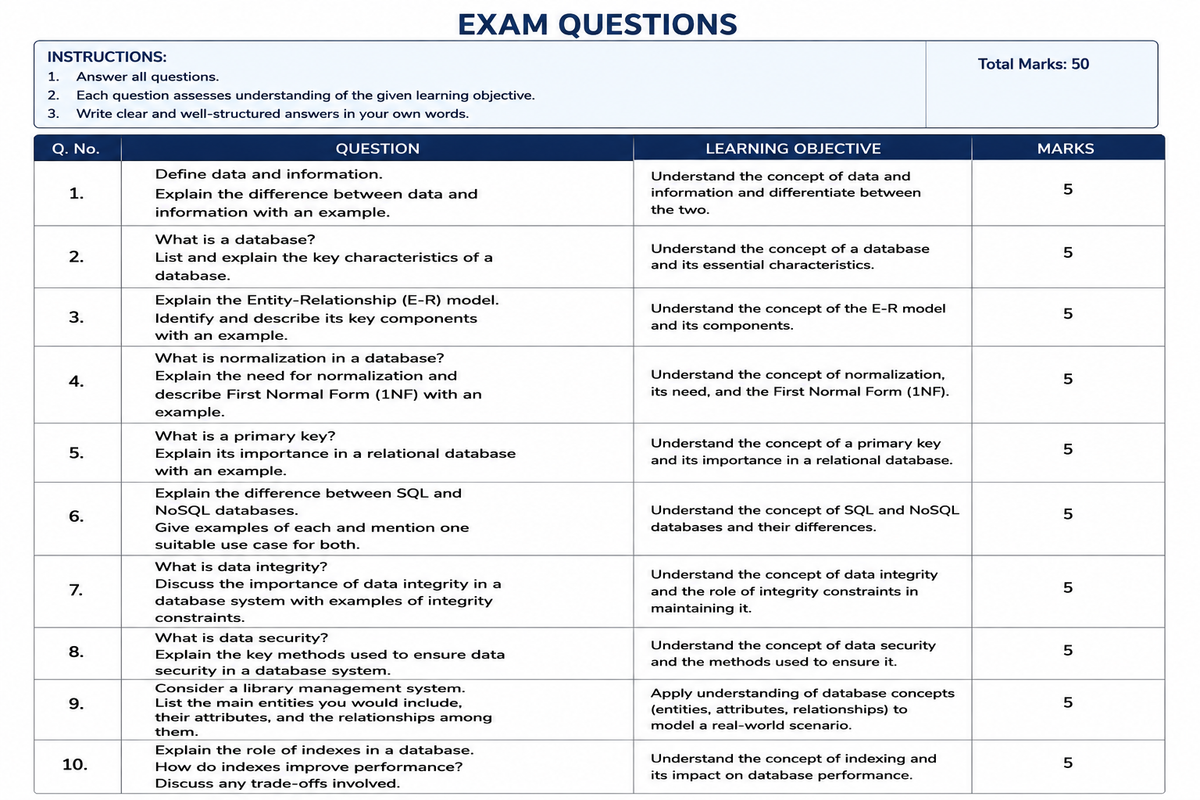
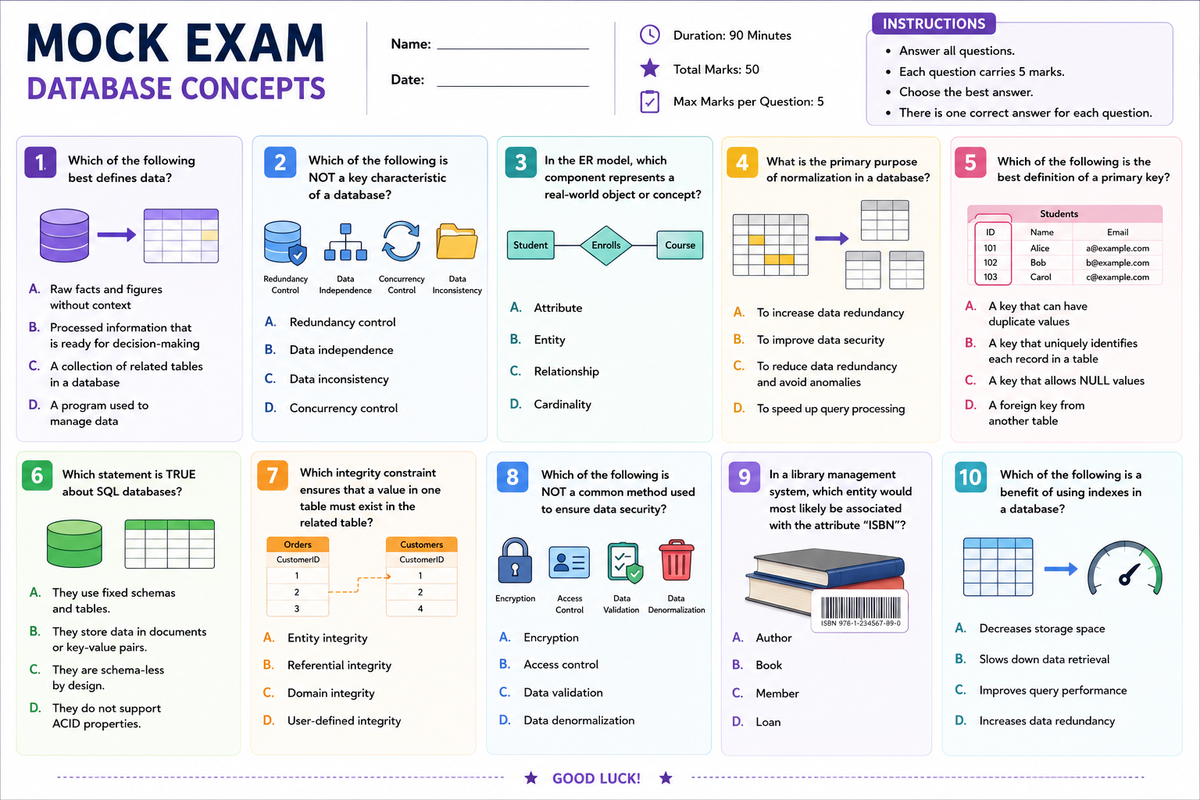
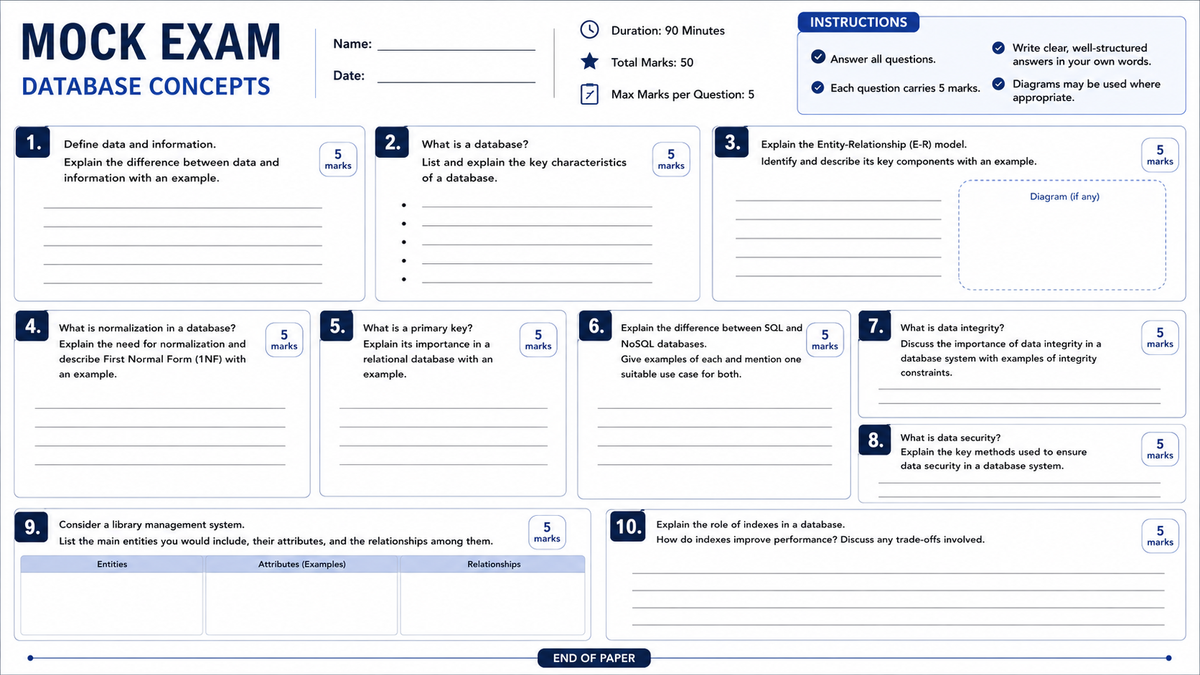
Writing exam questions is slow work, and the slow part is not the writing — it is making each question test the thing you meant it to test, at the right level, with wording no student can misread. The right ChatGPT prompts for exam questions help with all three, provided you tell the model the level, the learning outcome and the mark allocation.
There are 45 below, covering assessment design, objective questions, open response, practice papers, subject-specific sets, and the review pass. Run them in Chat Smith, a free AI chatbot that keeps several models in one place, or see the wider set of ChatGPT prompts for other work.
How to Use These Prompts Responsibly
Always review before use. Generated questions can be ambiguous, have two defensible answers, or arrive with an answer key that is simply wrong. Prompt 40 exists for exactly this — a question that reaches students unchecked is a question you will be defending in an appeal.
Verify every calculation and fact yourself. This matters most in maths and science, where models produce confident arithmetic that does not survive checking. Treat worked solutions as drafts.
Give it the level, outcome and format. "Write questions on photosynthesis" returns a worksheet. Naming the level, the learning outcome and the mark allocation returns something you could put on a paper.
Ask what misconception each distractor targets. A distractor that is merely wrong tests nothing. One that maps to a real student error tells you what to reteach.
Work in one thread. A long-context model such as GPT-5.6 Sol can hold your blueprint, syllabus and draft paper at once, which is what lets the review prompts work across a whole paper rather than one question at a time.
ChatGPT Prompts for Designing the Assessment
Seven prompts to run before writing a single question. A paper assembled from good individual questions can still be a bad assessment if the weighting, timing or cognitive spread is wrong.
1. The exam blueprint
Build an exam blueprint for [subject] at [level]. Topics and their teaching weight: [list them with hours or emphasis]. Total marks: [X]. Duration: [X minutes]. Produce a table mapping topics to marks, question types and cognitive level so the paper matches what I actually taught. Flag any topic over- or under-weighted relative to teaching time.
2. The learning outcome mapper
Here are my learning outcomes: [paste them]. For each, tell me what a student would have to do to demonstrate it, which question type can actually assess that, and which outcomes cannot be assessed in a written exam at all. Then flag any outcome I have phrased in a way that is untestable as written.
3. The cognitive level spread
Here is my draft question list: [paste it]. Classify each question by cognitive level — recall, understanding, application, analysis, evaluation, creation. Show me the distribution, tell me whether it suits an exam at [level] for [purpose], and identify which questions I could rewrite to move up a level without changing the topic.
4. The timing check
Here is my exam paper: [paste the questions with their marks]. Duration: [X minutes]. Estimate realistic completion time per question for a [level] student, including reading and planning. Flag where the paper is too long overall, which question consumes disproportionate time relative to its marks, and what I should cut.
5. The marking scheme builder
Here is an exam question: [paste it]. Total marks: [X]. Write a marking scheme with marks broken down by what earns them, model answer points, acceptable alternative answers, and common partial-credit scenarios. Then tell me where two markers would most likely disagree, so I can tighten the wording before anyone sits it.
6. The question type selector
I need to assess [describe the knowledge or skill] at [level]. Compare the available question types — multiple choice, short answer, structured, essay, practical — on what each actually measures, how long it takes to mark, and where it fails. Recommend the format for my purpose, and tell me plainly what it will not capture.
7. The fairness and access review
Here is my exam paper: [paste it]. Review it for barriers unrelated to the subject: unnecessarily complex sentence structures, cultural references not all students share, contexts assuming particular life experience, and instructions open to misreading. For each, suggest a neutral rewording that keeps the difficulty in the subject rather than in the language.
ChatGPT Prompts for Multiple-Choice and Objective Questions
Eight prompts where the distractors do the real work. A multiple-choice question is only as good as its wrong answers — and once you know what to drill, an AI quiz generator or AI flashcard generator handles the volume for student practice.
8. The MCQ set with real distractors
Write [number] multiple-choice questions on [topic] for [level]. Each needs one correct answer and three distractors representing actual student misconceptions rather than obviously wrong options. For each question, tell me which misconception each distractor targets. Avoid "all of the above" and "none of the above".
9. The distractor improver
Here are my multiple-choice questions: [paste them]. Review the distractors: which are implausible enough to eliminate without knowing the content, which sit so close to the answer that they are arguably also correct, and which repeat the same misconception across questions. Rewrite the weak ones and explain each change.
10. The stem cleaner
Here are my MCQ stems: [paste them]. Check each for the flaws that let test-wise students guess without knowing the content: grammatical cues matching one option, the correct answer being noticeably longer, negative phrasing that confuses rather than tests, and clues in one question that answer another. List every issue with its fix.
11. The misconception mapper
For [topic] at [level], list the eight most common student misconceptions and explain why students hold each one. Then write one diagnostic multiple-choice question per misconception, where selecting a specific distractor reveals it. Tell me what a class-wide pattern in each answer would mean for my teaching.
12. The true/false upgrade
Here are my true/false questions: [paste them]. These carry a 50% guess rate. Convert each into a format that tests the same knowledge more reliably — multiple choice, matching, or short answer — keeping the same content and difficulty. Then tell me which ones genuinely work better as true/false and should stay as they are.
13. The matching and sequencing set
Create a matching exercise and a sequencing question on [topic] for [level]. For the matching set, include more options than prompts so the last pair cannot be solved by elimination. For the sequencing question, explain what a partially correct order should earn. Provide the answer key with reasoning.
14. The difficulty calibrator
Here are [number] multiple-choice questions: [paste them]. Estimate the difficulty of each for a [level] cohort and explain what makes each easy or hard — content, wording, or distractor quality. Then tell me which questions are hard for the wrong reason: confusing phrasing rather than genuine challenge.
15. The scenario-based MCQ
Write [number] scenario-based multiple-choice questions on [topic] for [level]. Each should present a realistic short situation and require applying knowledge rather than recalling it. Keep scenarios under 60 words. Provide answers with an explanation of why each distractor is tempting but wrong.
ChatGPT Prompts for Short Answer and Essay Questions
Seven prompts for open response, where the command word and the mark allocation have to agree. Most complaints about unfair questions trace back to a mismatch between the two.
16. The short answer set
Write [number] short-answer questions on [topic] for [level], each answerable in two to four sentences. Vary what they ask for: define, explain why, compare, apply, evaluate. Include a model answer and the key points that earn marks. Avoid any question whose answer is a single word.
17. The essay question builder
Write [number] essay questions on [topic] for [level]. Each should require an argument rather than a description, be answerable in [time available], and be specific enough that a student cannot submit a pre-prepared answer. For each, state what the command word demands and what a top-band answer would do differently from a middle-band one.
18. The structured question builder
Build a structured multi-part question on [topic] for [level], worth [X] marks in total. Part (a) should be accessible to almost every student, with difficulty rising through the parts. Show the mark allocation, and make sure a student who gets part (a) wrong can still attempt the rest — no dependency chains.
19. The source-based question
Here is a source: [paste a text, data set, image description or extract]. Write [number] questions at [level] requiring students to work with this material rather than recall from memory. Include one asking them to evaluate the source's reliability. Provide indicative answers, and note what the source does not actually support.
20. The command word calibrator
Here are my questions: [paste them]. Check each command word — describe, explain, analyse, evaluate, justify, compare — against what the question actually demands and what the marks suggest. Flag every mismatch, such as an "evaluate" worth two marks or a "state" worth eight, and rewrite those questions.
21. The problem-solving question
Write [number] problem-solving questions on [topic] for [level]. Each should require multiple steps, with marking that rewards method as well as the final answer. Provide a full worked solution, the mark breakdown by step, and the most common error students make at each stage. Verify the arithmetic before presenting it.
22. The analytic rubric
Here is an open-response question: [paste it]. Write an analytic rubric with [number] criteria and four performance bands each. Describe every band in terms of what the work does rather than adjectives like good or excellent. Then tell me which two bands markers most often confuse, and how to distinguish them in practice.
ChatGPT Prompts for Practice Tests and Question Banks
Seven prompts for producing material at volume: full papers, parallel forms, and banks you can draw from all year. Pair them with a PDF summarizer when you are generating questions from a syllabus document or textbook chapter.
23. The full practice paper
Create a complete practice exam for [subject] at [level]. Duration: [X]. Total marks: [X]. Topics with weighting: [list them]. Include a mix of question types, rising difficulty within each section, clear instructions and mark allocations, plus a separate answer key. Mirror the format of [name the exam or board] — and tell me explicitly if you are unsure of its current format rather than guessing.
24. The parallel form
Here is an existing exam paper: [paste it]. Create a parallel version testing the same outcomes at the same difficulty, using different questions, contexts and numbers. Map each new question to the original it replaces, and flag any where you could not match the difficulty closely.
25. The question bank builder
Build a question bank on [topic] for [level]: [number] questions tagged by subtopic, cognitive level, question type and estimated difficulty. Format it as a table I can paste into a spreadsheet. Keep coverage even across subtopics, and tell me where the bank is thin so I know what to add.
26. The adaptive quiz
Quiz me on [topic] one question at a time, adjusting difficulty based on my answers. If I get one wrong, ask an easier question on the same idea before moving on. After [number] questions, tell me the level at which my understanding breaks down and which subtopic to revise first.
27. The retrieval practice set
Turn this material into a retrieval practice set: [paste your notes or syllabus section]. Produce [number] questions designed for spaced repetition rather than exam simulation — short, single-concept, answerable from memory. Mark which should recur most often based on how easily each is forgotten.
28. The past paper analyser
Here are questions from several past papers on [subject]: [paste them]. Identify the recurring question types, the topics examined most often, the phrasing patterns examiners favour, and what has not appeared recently. Then predict the shape of the next paper — and be explicit about how much confidence that prediction actually deserves.
29. The mock exam brief
I am running a mock exam for [subject] at [level] in [timeframe]. My students' weakest areas: [describe]. Design the mock: what to include, what to deliberately over-represent given those weaknesses, the conditions to run it under, and the feedback structure afterwards. Then tell me what a mock cannot tell me about readiness.
Subject-Specific ChatGPT Prompts for Exam Questions
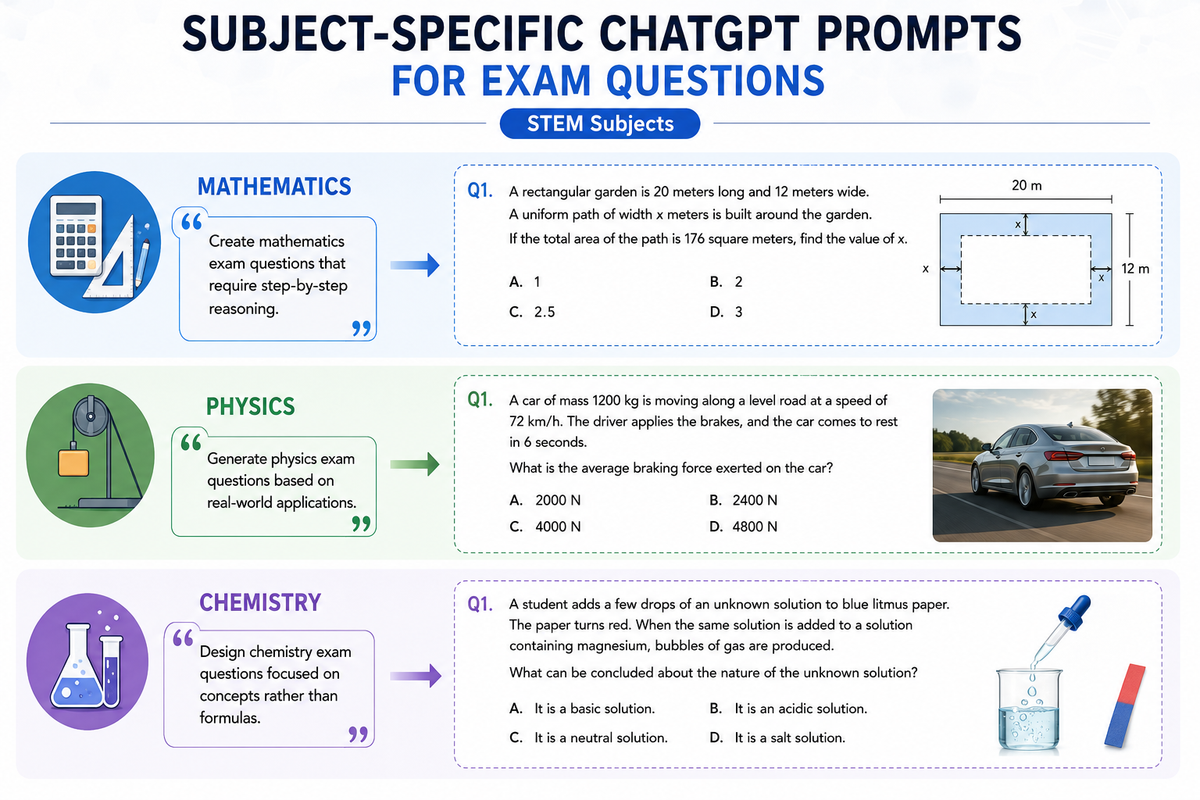
Eight prompts adapted to what each subject actually assesses. For anything numerical, check the working with an AI math solver or by hand before it reaches a student, and browse the other AI study tools for classroom material.
30. Mathematics
Write [number] mathematics questions on [topic] for [level], mixing procedural fluency, reasoning and problem-solving in context. Provide full worked solutions with method marks identified, and flag the step where students most commonly go wrong. Check every calculation before presenting it and tell me if any answer does not come out cleanly.
31. Science and practical work
Write [number] questions on [topic] for [level] science, including at least two based on experimental method — variables, controls, sources of error, or interpreting results. Provide answers, and for the practical questions state what a student would need to have actually done the experiment to answer well.
32. Language and literature
Write [number] questions on [text or topic] for [level] literature: close-reading questions tied to a specific passage, one comparative question, and one requiring a personal argued response. Provide indicative content rather than a single correct answer, since interpretation legitimately varies.
33. History and social science
Write [number] history questions on [topic] for [level]: one source-evaluation question, one on causation, and one requiring a judgement supported by evidence. Provide indicative answers, and note where historians genuinely disagree so the marking does not penalise a defensible alternative interpretation.
34. Business and economics
Write [number] questions on [topic] for [level] business or economics, including one data-response question using a realistic short data set and one requiring evaluation of a decision with trade-offs. Provide answers, and note which parts depend on assumptions students should be stating explicitly.
35. Computing and technical subjects
Write [number] questions on [topic] for [level] computing: one code-reading question, one requiring students to identify and fix an error, and one design question with no single correct answer. Provide answers, and for the design question describe the range of acceptable approaches rather than one model solution.
36. Vocational and applied subjects
Write [number] questions for [vocational subject] at [level] that assess applied competence rather than recall. Base each on a realistic workplace scenario and state what a safe or professionally correct answer must contain. Flag anything where local regulation or standards vary, since the correct answer differs by region.
37. Language learning
Write [number] assessment items for [target language] learners at [CEFR level or equivalent], covering reading comprehension, grammar in context, and one productive task. Provide answer keys, and for the productive task give a rubric assessing communication rather than accuracy alone.
ChatGPT Prompts for Reviewing and Marking
Eight prompts for the stage that matters most, and the one most often skipped. Prompt 40 in particular should run on every set of questions before students see them — and an AI homework solver is a useful second opinion when you want an answer checked independently.
38. The question quality review
Review these exam questions as an experienced assessment designer: [paste them]. Level: [X]. For each, check clarity of wording, alignment to the stated outcome, appropriateness of difficulty, and whether the mark allocation matches the demand. Flag anything ambiguous, then rewrite the three weakest questions.
39. The ambiguity hunter
Here is an exam question: [paste it]. Read it as five different students would: one who knows the material well, one who knows it partially, one who reads very literally, one whose first language is not the language of instruction, and one who is rushing. Where could each misread it? Then rewrite to remove every ambiguity you found.
40. The answer key verifier
Here are my questions and my answer key: [paste both]. Work out each answer independently before comparing it to my key. Flag any where you reach a different answer, where more than one option is defensible, or where the question as worded does not have the answer my key claims. Do not assume my key is correct.
41. The discrimination check
Here is my paper: [paste it]. My cohort: [describe their ability range]. Tell me the likely distribution of scores, whether the paper distinguishes strong students from weak ones or merely separates those who revised, and which questions almost everyone will get right or wrong — both of which carry very little information.
42. The reading demand check
Here is my exam paper: [paste it]. Assess the reading demand of the questions themselves against the level of my students. Identify any question where the language is harder than the concept being tested, and rewrite it in plainer language without making the subject content any easier.
43. The feedback writer
Here is a student's answer, the question, and the marking scheme: [paste all three]. Write feedback saying what they did well, what specifically cost them marks, and the single change that would most improve their next answer. Address the work rather than the student, and keep it under 100 words.
44. The common errors summary
Here is a set of student answers to the same question: [paste them or summarise the patterns]. Identify the recurring errors, distinguish careless slips from genuine misconceptions, and tell me what to reteach versus what to simply flag. Then suggest one question that would confirm whether the reteaching worked.
45. The post-exam analysis
Here are the results from my exam: [paste per-question performance data]. Identify which questions performed poorly as assessment items — everyone right, everyone wrong, or strong students getting them wrong more often than weak ones. For each, tell me whether the problem is the question or the teaching, and how I would tell the difference.
Using These Exam Prompts in Chat Smith
Assessment work repeats every term with different content, which makes it worth saving properly. Chat Smith lets you keep your blueprint prompt, your MCQ format and your review checklist as reusable templates, group them by subject or year group, and share the set with colleagues teaching the same course so questions arrive in a consistent house style.
It also runs several AI models side by side, which has a specific use in assessment: send the same question and answer key to two models independently and see whether they agree on the answer. Where they disagree, you have found an ambiguous question before a student does — which is considerably cheaper than finding it afterwards.
Start with the blueprint before writing questions, and the answer key verifier before printing anything. Those two bracket the whole process, and between them they catch most of what goes wrong with a paper.
They are instructions asking an AI model to write test items from your material: multiple choice with distractors, short answer, essay questions, or a full paper with a marking scheme. The useful ones supply the source text, the level and the exact learning objective being tested.
The Chat Smith Editorial Team brings together AI enthusiasts, researchers, and creators to make AI accessible and practical. We share trends, tool reviews, and actionable guides that help individuals and businesses stay informed, boost productivity, and get more from AI.