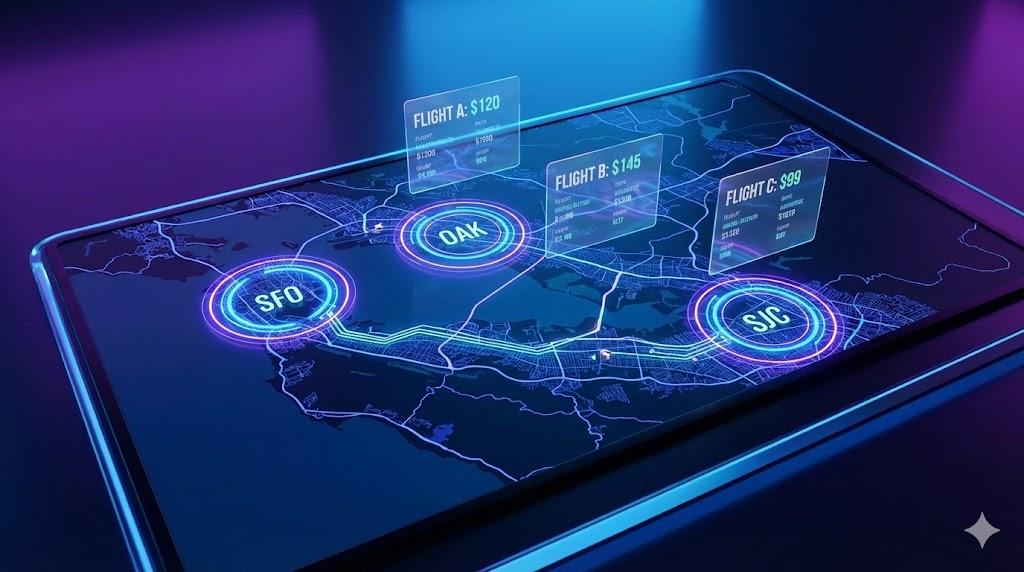
A language model cannot see flight prices. It does not know what a seat costs today, which airlines currently fly a route, or whether anything is available. Ask it for the cheapest fare to Tokyo next month and it will give you a number that looks entirely plausible and came from nowhere.
What it is genuinely good at is everything around the search: working out which airports and dates to check, explaining what a fare actually includes, turning a pile of options into a comparison you can read, and catching the cost you forgot. Do that thinking first, then go and search on a real booking tool with a much better plan than you would otherwise have had.
The twenty-five below are written that way. They work in ChatGPT and any comparable model, and for prompting technique across other kinds of work see the main ChatGPT prompts guide.
What a Model Cannot Tell You About Flights
Any price it gives you is invented. Fares change constantly and a model has no access to them. Treat every figure it produces as an illustration of a shape, never as a number to plan around. Check the actual price on a booking site before any of it means anything.
Routes and schedules go out of date. Airlines drop routes, change hubs and stop flying. A suggested connection may not exist any more, so use its suggestions as a list of things to check rather than a plan.
It will repeat travel folklore confidently. Book on a Tuesday, browse in a private window, book exactly so many days ahead. A great deal of this is contested or was never well evidenced, and a model has no way of distinguishing a widely repeated claim from a true one. Ask it to flag anything it is asserting from general advice rather than from something you supplied.
Visa, transit and entry rules must be checked officially. These change without warning and getting them wrong means not boarding. Use a model to work out what questions to ask, then confirm every answer with the airline and the relevant government source. Nothing on this page is a substitute for that.
Be careful what tricks you act on. Some well-known fare tactics, such as booking a longer itinerary and leaving at a connection, breach most airlines' conditions of carriage. Consequences can include the rest of the ticket being cancelled and loyalty accounts being closed. A model will explain these tactics happily; it will not warn you about the terms unless you ask.
Flight Search Planning Prompts
Five prompts to run before you open a booking site. The point is to arrive at the search knowing exactly what to type, rather than trying one route and accepting whatever comes back.
1. Build the search plan
I want to fly from [origin] to [destination] around [dates], and my real constraints are [describe: fixed dates or flexible, bags, travelling with others, must arrive before something]. Build me a search plan: every origin airport within reasonable reach, every destination airport that serves my actual final location, the date range worth checking, and the order to search in. Do not estimate any prices.
2. Which flexibility is worth having
Here is how flexible I can be: [describe what you could shift - dates, airports, time of day, stopping over, direction of travel]. Rank these by how much difference each typically makes to fare on a route like mine, and tell me which one I should try first. Be explicit that this is general reasoning rather than current pricing.
3. What the trip actually requires
I am travelling for [describe the purpose and who with]. Ask me eight questions that would establish what this trip genuinely requires - arrival time, energy on arrival, luggage, risk tolerance for a tight connection - before I start optimising for price. I want to know what I should not compromise on.
4. Seasonality and events
I am considering travelling to [destination] in [month]. Tell me what is happening there in that period that would affect demand - school holidays, major events, national holidays, monsoon or peak season - and which weeks to avoid or target. List anything I should verify, since event dates move year to year.
5. Set the budget honestly
My total budget for getting there and back is [amount]. List everything that has to come out of it besides the fare: bags, seat selection, transport to and from airports, an airport meal, travel insurance, and anything else I have not thought of. Tell me what is actually left for the ticket itself.
Prompt 5 is the one people skip and regret. A fare that looks cheap and then needs a hold bag, a seat and a two-hour transfer at each end is often the expensive option.
Prompts for Widening Your Flight Options
Five prompts for finding the searches you would not have thought to run. Everything here produces a list to check, not an answer.
6. Every airport worth trying
I am starting from [location] and going to [location]. List every airport within [time] of each end, with how long the ground journey takes and roughly what it costs. Flag any where the transfer would eat the saving, and any that only make sense if I am travelling without checked bags.
7. Routings I have not considered
For [origin] to [destination], list the plausible connecting hubs and which airlines or alliances typically route that way. I will verify current schedules myself - I want the list of routings to search, including any that look indirect but are commonly used on this pair.
8. Split the journey
Would booking [origin] to [hub] and [hub] to [destination] as two separate tickets be worth checking on this route? Explain what I gain, and be specific about what I lose: no protection if the first flight is late, bags to reclaim and recheck, and possible visa requirements for the transit country. Tell me how much minimum connection time I should leave to make it sane.
9. Nearby dates, ranked
My ideal dates are [dates] and I could shift by up to [number] days either way. Given how demand usually works on a route like this, tell me which alternative dates are most worth checking first and which are almost certainly worse. Make clear this is a heuristic and not a price check.
10. The stopover as a feature
I am flying [origin] to [destination] and would consider stopping somewhere for a few days if the routing allows it. Which hubs on this pair would make a worthwhile stop, what would I need to check about transit or entry requirements for each, and how much extra time would I need to build in?
Treat all five outputs as a checklist to run through a real search engine. The value is that you now know what to search, not that you know what it costs.
Five prompts for reading a fare properly. This is where a model is at its most useful, because fare rules are written to be difficult and explaining difficult text is exactly what it does well.
11. Translate the fare rules
Here are the fare conditions for a ticket I am considering: [paste them]. Explain in plain language what I can and cannot do: change it, cancel it, choose a seat, take a bag, get a refund, and what each would cost. Flag anything ambiguous that I should ask the airline directly.
12. The true total
Here is a fare and what it includes: [paste the details]. Here is what I actually need: [bags, seat together, specific timing]. Work out the real total once I have added everything I need, and list anything I might get charged for at the airport that is not obvious from the booking page.
13. Basic versus standard
Here are two fares on the same flight: [paste both]. Explain exactly what the cheaper one gives up. Then tell me under what circumstances the difference would cost me more than the saving, so I can decide rather than guess.
14. Baggage, properly
Here is my itinerary with [number] airlines involved: [describe]. Explain how baggage allowance works across the whole journey when different carriers have different rules, which airline's rules apply on each leg, and what I should confirm before travelling. Tell me what happens to my bag at each connection.
15. Where the risk actually sits
Here is the itinerary I am about to book: [describe, including connection times and whether it is one ticket or several]. Tell me what happens if each leg is delayed or cancelled, who is responsible in each case, and which single point in the journey carries the most risk. Be specific about whether I would be rebooked or left to sort it out myself.
Paste the actual conditions rather than describing the fare. A model reading real text is reliable; a model recalling how airlines usually work is not.
Prompts for Comparing Flight Options
Five prompts for after the searching. Paste the real options you found and the model becomes genuinely useful, because now it is working with actual data instead of memory. Our ChatGPT prompts for data analysis apply the same principle to any comparison.
16. Turn the tabs into a table
Here are the flight options I found, pasted roughly as they appeared: [paste them]. Turn them into one table with columns for total price including bags, total door-to-door time, number of connections, shortest connection, arrival time at my final destination, and change flexibility. Do not add any option I have not given you.
17. Cost per hour saved
Here are two options, one cheaper and slower, one dearer and faster: [paste both]. Calculate what each hour saved is costing me, then tell me what else that difference buys on this trip. I want the arithmetic, not a recommendation.
18. What I have not accounted for
Here is the itinerary I am leaning towards: [paste it]. List every cost and inconvenience I have probably not counted: airport transfers at both ends, an overnight if the arrival is late, food during a long layover, a lounge or not, and getting to the airport at an awkward hour. Give me the honest total.
19. Argue against my choice
I have decided on this option: [paste it]. Here is why: [explain]. Make the case against it, using only the options I gave you. Tell me what I am underweighting and whether the saving is worth what it costs me. Be direct.
20. Book now or wait
Here is the fare I am looking at and my situation: [describe, including how fixed the trip is and how bad it would be to miss out]. Help me think about whether to book now, framed as a decision under uncertainty rather than a price prediction. State clearly that you cannot forecast the fare, and give me the conditions under which waiting is rational.
Prompt 18 is where the money actually is. The cheapest fare and the cheapest trip are frequently different bookings, and the gap is usually made of transfers and an unplanned hotel night.
Prompts for Layovers, Delays and Claims
The last five, covering everything the fare does not. Two of these are for when something has gone wrong, which is the point at which most people wish they had read the conditions.
21. What to check before booking
I hold [nationality] documents and my itinerary is [describe, including every country I would pass through]. List everything I need to verify before booking: entry requirements, transit rules, passport validity, onward ticket requirements. Do not tell me the answers - tell me exactly which official source to check for each, because these change and getting one wrong means not boarding.
22. Is this connection realistic
I have [duration] to connect at [airport], arriving on [airline] and departing on [airline]. Walk me through what actually has to happen in that time: terminal change, immigration, security again, bag recheck. Tell me what would make this tight and what I should do if the inbound is late.
23. The long layover
I have [duration] at [airport] between flights, arriving at [time]. Tell me what is realistically possible: whether leaving the airport makes sense given transit rules I would need to check, what is available inside, and where I could sleep if it is overnight. Be honest if the answer is that I should just book a different flight.
24. Something went wrong
My flight was [describe what happened and the delay]. Here is my ticket and the route: [describe]. Explain what the airline is generally obliged to offer in a situation like this, what I should ask for at the desk, and what to keep for a claim. Tell me which rules depend on jurisdiction so I know to look up the ones that apply to my route.
25. Write the claim
Here is what happened, with times and reference numbers: [describe]. Draft a claim to the airline: factual, chronological, stating what I am asking for and the basis for it. Under 300 words, no anger, no threats. Then list the documents I should attach and what to do if they refuse.
Prompt 21 is the only one on this page where being wrong has a hard consequence. Use it to build the checklist, then verify every item with the airline and the relevant government source rather than with a model.
Using These Cheap Flight Prompts in Chat Smith
For this subject the distinction that matters is whether the model can reach the live web at all. One that can browse may be able to check a current route or an airline's published conditions; one working from training data alone cannot, whatever it sounds like. Grok 4.5 is worth trying where currency matters, and the model list shows what else is available. Either way, confirm anything that affects boarding with the airline directly.
The habit that makes all twenty-five work: paste real material rather than describing it. Real fare conditions, real search results, real itineraries. A model reading text you gave it is reliable; the same model recalling how airlines generally behave is guessing fluently. Chat Smith is free to try.
And one line worth adding to every prompt on this page: tell me which parts of your answer you cannot verify. It costs nothing, it takes one clause, and on a subject made almost entirely of live data it is the difference between a plan and a story.
They are instructions that ask an AI model to help you search smarter: comparing routing options, suggesting flexible date windows, listing nearby airports, explaining fare rules, or shaping a multi-city trip. It plans the search; it does not price or book the ticket.
The Chat Smith Editorial Team brings together AI enthusiasts, researchers, and creators to make AI accessible and practical. We share trends, tool reviews, and actionable guides that help individuals and businesses stay informed, boost productivity, and get more from AI.